
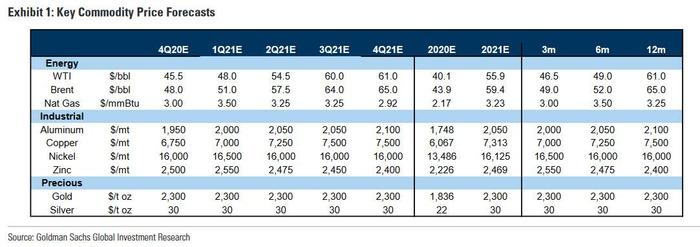
Summary: Driven by a weaker dollar, rising inflation risks, and additional fiscal and monetary stimulus from major economies, the commodities market is set for a structural bull market next year.
Jeffrey Currie, Goldman Sachs' chief commodities strategist, said Thursday that the commodities market will see a structural bull market next year, supported by a weaker dollar, rising inflation risks, and additional fiscal and monetary stimulus from major economies.
Goldman Sachs said the market is increasingly concerned about a rebound in inflation, forecasting a 28% return for the S&P GSCI over the next 12 months, with precious metals returning 17.9%, energy commodities 42.6%, industrial metals 5.5%, and agricultural products -0.8%.
A key catalyst for the bank's bullish view is that "almost all commodity markets are in or nearing a deficit, except for cocoa, coffee, and iron ore." As Currie noted, "Such broad-based deficits are typically only seen late in the economic cycle, highlighting the existence of a uniquely positioned market. Given that inventories are already being drawn down early in the cycle, we expect a structural bull market in commodities in 2021." The strategists believe the bull market will be driven by three main themes: ① Structural underinvestment in the old economy;
② Policy-driven demand;
③ Macro tailwinds from a weaker dollar and rising inflation risks.
Currie pointed out, "These drivers are consistent with the bank's optimistic view since the start of this year, and have now been amplified by the disruption of the pandemic and the subsequent global policy response." He said that as deficits emerge, as long as external demand does not completely collapse, the market will move toward a state of rebalancing. For example, in recent months, declining capital expenditure on oil extraction in OPEC countries has gradually slowed production activity, with global energy supply and demand gradually shifting from the oversupply seen at the peak of the pandemic toward a tighter balance.
Inflation expectations are a potential tailwind for commodities. Goldman Sachs believes that due to historic levels of fiscal spending and persistently low interest rates, the market is increasingly worried about the return of inflation. To offset this risk, investors may drive more investment into commodities. "The trend of rising demand, coupled with investor complacency toward inflation, increases the potential risk of rising prices. As an inflation hedge, the market opportunities for commodities will increase," the report said.
Goldman Sachs also noted that the Federal Reserve's commitment to keeping interest rates near zero for the coming years could lead to a weaker dollar over the long term, which would be supportive of commodity prices. Continued increases in raw material prices will ultimately push inflation higher.
For specific commodities, Goldman Sachs forecasts Brent crude oil at $49 per barrel in three months, $52 per barrel in six months, and $65 per barrel in twelve months.
Currie is particularly focused on gold. He expects expansionary fiscal and monetary policies in developed economies to continue pushing interest rates lower, creating demand for hedging tail risks from inflation, thereby boosting precious metals. Accordingly, Goldman Sachs expects gold to average $1,836 per ounce in 2020 and $2,300 per ounce in 2021. It also forecasts silver to average $22 per ounce in 2020 and $30 per ounce next year.