
Abstract: Heading into the "Golden September and Silver October" peak season, apart from a certain amount of seasonal strength in power-sector copper consumption, consumption in areas such as home appliances and automobiles is unlikely to significantly exceed expectations.
As the "Golden September and Silver October" peak season gets under way, besides a seasonal uptick in copper use in the power industry, consumption from sectors like home appliances and automobiles is unlikely to beat expectations significantly. Domestic copper is still in a destocking phase, but with almost no major maintenance plans at domestic smelters in September, refined copper supply is set to recover fairly markedly. Combined with the fact that the LME is building inventories, the possibility of inventory accumulation in China cannot be ruled out, driven by imports.
In September, copper prices remain elevated and volatile, but the highs are clearly lower than those of May and July. The main bearish factor is the macro landscape; micro supply and demand fundamentals have yet to form a bearish confluence. Low inventories and the recovery of some deferred consumption will support copper prices. In the medium term, however, we maintain our view that copper prices will oscillate lower, mainly for the following reasons: First, the Fed's tapering of QE is an inevitable trend that will not be changed by the weak August non-farm payrolls. Second, the global economic recovery has basically peaked, and high inflation and excessive speculation in financial markets are causing monetary policy shifts to spread from emerging markets to advanced economies such as South Korea. Third, as copper mine and refined copper supply resume growth, demand weakens, or peak-season consumption disappoints, copper enters an inventory-building phase, potentially creating a bearish confluence of macro and micro factors. Fourth, "Golden September" and "Silver October" peak-season consumption may turn out to be lackluster, and inventory accumulation cannot be ruled out.
[1] High inflation makes Fed tapering within the year an inevitable trend. Although the US non-farm payroll data for August came in well below expectations, we believe that in the current high-inflation environment, continued QE may have more negative than positive effects, and tapering within the year is an inevitable trend.
First, high inflation may challenge the MMT (Modern Monetary Theory) pursued by the Fed. MMT generally holds that the Fed can finance US fiscal deficits at no cost—"domestic debt is not debt"—but the eventual exit of such debt must ultimately be brought back into the government's spending accounts. If government spending is fully monetized, refinancing will inevitably push up interest rates and eventually inflict huge damage on the US economy.
Second, the US financial system is awash with liquidity. If the Fed does not exit QE in time, it may face stagflation and asset-bubble risks, as well as the friction costs necessarily incurred in the exit process. Because excess reserves at banks and other financial institutions currently cannot generate commercial credit, huge liquidity has poured into short-term Treasury, interbank lending and repo markets. The spread between the effective federal funds rate and the offering yield of the overnight reverse repurchase facility has kept narrowing, and the size of the Fed's ONRRP has kept expanding.
We believe the Fed's delayed signal of tapering is intended to reduce the impact and friction costs of exiting QE. Therefore, with inflation high and bank excess reserves unable to create commercial credit, the Fed's exit from QE is an inevitable trend. The market now concerns itself only with the short-term pace and has not yet focused on this trend.
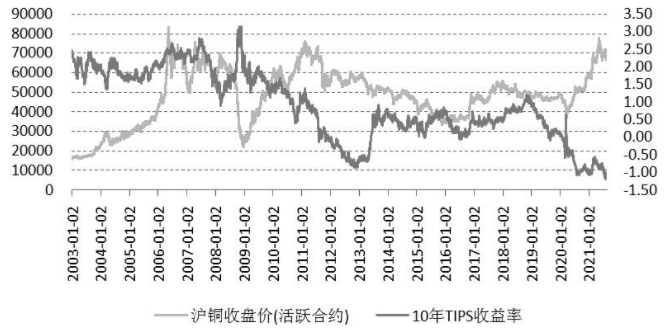
Should the Fed exit QE, US Treasury yields look set to rebound markedly, thereby curbing copper's investment demand. In terms of copper's investment attribute, the lower the real dollar interest rate, the more investment capital flows into the copper market and the stronger speculative buying becomes. The relationship between the real dollar interest rate and copper prices is negative. After the release of the Fed's July FOMC meeting minutes, nominal US rates rose again, which also pulled real rates off their lows; this will weigh on copper's investment appeal.
[2] Passive restocking in industry and another round of structural policy in China. Judging by leading indicators, after a broad weakening of economic indicators in July, manufacturing and services remained poor in August. Data show that China's manufacturing PMI stood at 50.1% in August, down 0.3 percentage points from the previous month, indicating that manufacturing expansion slowed somewhat. In terms of seasonal factors, manufacturing sentiment in August this year was still lower than the historical norm.
Notably, we believe manufacturing may currently be in a passive restocking stage and is about to enter active destocking. Historically, active destocking manifests as economic weakening plus falling industrial product prices. In August, the manufacturing new orders index fell to 49.6%, down 1.3 percentage points from the previous month and below the threshold, indicating weaker demand in the manufacturing market. The new export orders index declined further to 46.7%, the lowest since June 2020. The raw material inventory index was 47.7%, unchanged from the previous month but still below the threshold, indicating that manufacturers' main raw material inventories declined from the previous month. The finished-goods inventory index, however, rose 0.1 percentage point from the previous month, further confirming our judgment of passive restocking in industrial firms.
Industrial enterprise profit data show that upstream firms' profits grew at a high rate in July, but profit growth at mid- and downstream firms declined noticeably as margins were squeezed. This means large-scale stimulus policies are unlikely; any policy support is likely to be structural. Risk appetite in the market is in fact not low. If the floodgates were opened, it could spur a new round of leverage building by property developers and local governments. Consequently, both the State Council executive meeting and the central bank's meeting on money and credit conditions at financial institutions stressed that there will be no "flood-like" stimulus. Instead, moderate monetary growth should support high-quality economic development, help small and medium-sized enterprises and distressed industries recover, and keep the economy within a reasonable range.
On September 1, the State Council executive meeting arranged to increase support for market entities, especially micro, small and medium-sized enterprises, strengthen policy reserves, and make cross-cyclical adjustments. Structural policies include: first, an additional 300 billion yuan in relending quota for small businesses this year, supporting local corporate banks in extending loans to small and micro enterprises and self-employed individuals; second, fiscal policy could be strengthened—the meeting required coordinated cross-cyclical adjustments, which means the issuance of special-purpose bonds and their effects may be brought forward to early next year.
[3] "Golden September and Silver October" arrive, but peak-season consumption is hard pressed to show highlights. We believe that apart from some seasonal performance in power-sector copper consumption, consumption in home appliances, automobiles and other areas is unlikely to exceed expectations. September and October are the peak period for the start and construction of infrastructure investment projects. Against the backdrop of carbon neutrality and carbon peaking, solar and wind power project starts and construction are expected to see a seasonal mini peak, but the strength will be weaker than in the first half of the year. Looking at copper rod processing fees, as copper prices fell, previously deferred copper rod consumption has shown clear signs of recovery. As of September 1, the 8mm copper rod processing fee recovered to 590–790 yuan/tonne, after high copper prices had earlier curbed copper consumption and pushed the fee down to 300–500 yuan/tonne in May. However, the current copper rod processing fee is still lower than the 700–900 yuan/tonne in the same period last year.
From the second quarter, power investment declined significantly and had not yet picked up noticeably by July. In Q1 2021, year-on-year growth of power generation investment and grid investment was 25.5% and 27.2% respectively, but in January-July 2021, the growth rates fell sharply to 4.1% and .2%. Among them, wind power investment growth fell to 46.9%, which reflected both the base effect and the investment slump under high costs and tight credit in Q2.
For new energy vehicles, we believe that under the combined influence of a high base in the same period last year, the chip shortage and the lack of obvious acceleration in household income growth, the year-on-year growth of NEV production and sales during the "golden September and silver October" period may face a relatively large risk of decline. New energy vehicles mainly cover three segments: upstream lithium batteries and motor raw materials, midstream motors, motor controllers and batteries, and downstream complete vehicles, charging piles and operations. Among these, the copper wire demand from lithium batteries is a growth point for copper consumption.
However, in August, passenger vehicles showed large negative year-on-year growth in both retail and wholesale. Data from the China Passenger Car Association (CPCA) show that in the fourth week of August, daily average retail sales in the passenger car market reached 76,000 vehicles, down 12% year-on-year, a relatively weak performance. The preliminary estimate for August is a year-on-year decline of about 13%, with consumption trends fairly lackluster and sluggish.
For home appliances, July-August is the traditional peak season for air-conditioning consumption, but the growth in copper tube consumption in the household air-conditioning industry slowed. Structurally, central air-conditioning and cold storage industries performed well, but the growth in copper use in cold storage is not sustainable: because the pandemic has slowed logistics, once the pandemic eases and logistics recovers, cold storage demand will slow. In September, as high temperatures fade, copper consumption in the air-conditioning sector is expected to enter the off-season.
On the whole, historical experience shows that a trend-level sharp rise or sharp fall in copper prices requires both macro and micro resonance. The current downward pressure on copper prices comes from macro-level negatives: tapering of QE by the Fed is a prevailing trend, and real U.S. interest rates will rebound significantly; the global economy is peaking and monetary policy is turning, so both investment demand and consumer demand for copper face downside risks; and domestic economic growth is slowing with passive restocking, but the possibility of loose monetary policy remains small, with structural policies taking the lead.
From the micro level, entering the "golden September and silver October" peak season, we believe that apart from the expected seasonal performance of copper use in the power industry, consumption in fields such as home appliances and automobiles is likely to have difficulty exceeding expectations. At present, domestic copper is still in the destocking phase, but there are almost no major maintenance plans at domestic smelters in September, so refined copper supply will recover fairly noticeably. Considering also that the LME is accumulating inventories, under import-driven conditions, the possibility of domestic inventory accumulation cannot be ruled out.