
SMM May 6 — The first trading day of May came to a close, and China's three major A-share indices suffered a 'black opening' and plunged across the board. The Shanghai Composite Index fell 5.58%, the Shenzhen Component Index fell 7.56%, and the ChiNext Index fell 7.94%. The market was in agony, with a total of 1,062 stocks hitting limit-down, 3,466 stocks falling, and 1,918 stocks down more than 8%. The gains recorded since the start of the year vanished in an instant, leaving the market feeling as if it had been thrown back to 2018 overnight.
It was not just Chinese A-shares. Stock markets around the world slid broadly. Hong Kong's Hang Seng Index fell more than 3%, most other Asian indices dropped more than 1%, and European indices opened sharply lower, down nearly 2%. The three major U.S. stock index futures at one point fell more than 2%, while the VIX panic gauge jumped over 10%. It is foreseeable that U.S. stocks will not escape unscathed tonight.
In the commodity sector, the two oil majors fell nearly 2%, while the six non-ferrous metals declined collectively. The ferrous (black) chain performed slightly better, with iron ore, coking coal and coke all rising by varying degrees.
In the foreign exchange market, the volatile offshore RMB briefly broke through 6.82 before stabilizing around 6.78, down 500 pips.
According to reports, U.S. President Donald Trump once again threatened to raise tariffs, triggering a fresh wave of panic in global markets. At the Foreign Ministry press conference on May 6, a reporter asked about Trump's claim that he would impose tariffs on Chinese goods and the next round of China-U.S. trade consultations. Foreign Ministry spokesman Geng Shuang said that similar situations involving U.S. threats to impose tariffs on Chinese products have occurred many times before. 'What I can tell you is that the Chinese team is preparing to go to the U.S. for consultations,' he said. The spokesman's remarks may bring some confidence to the market.
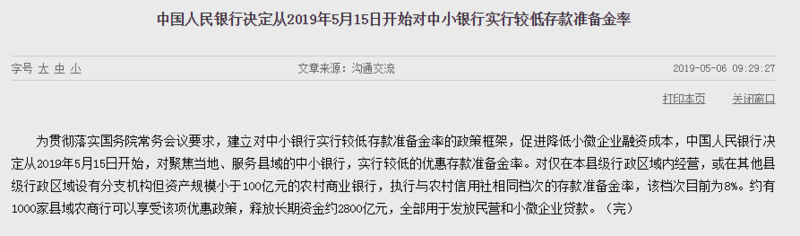
Notably, less than one minute before the morning open, the central bank made a rare announcement that it would implement a targeted cut to the reserve requirement ratio (RRR) for small and medium-sized banks from May 15, 2019, releasing 280 billion yuan, all of which will be used to support lending to private enterprises and small/micro businesses.
Economist Deng Haiqing commented that the central bank usually announces major monetary policy operations after trading hours, possibly to reduce market disruption and information asymmetry caused by uneven access to information. This time, however, the central bank announced the major policy move during trading hours, most likely to boost market confidence. Affected by external factors, overseas risk assets have fallen sharply; it is foreseeable that Chinese equities would be hit even harder, not less. The Shanghai Composite's 3% opening decline confirmed that market confidence is severely lacking and requires policy support.
Ming Ming, chief fixed income analyst at CITIC Securities, said that since 2012, the central bank had never implemented an RRR cut in May. The sudden timing of this cut highlights the government's determination to stabilize both the real economy and financial market fluctuations. This year, the introduction of monetary policies including RRR cuts has already broken away from the previous policy framework based on liquidity gaps. Counter-cyclical adjustments and credit concerns have become the key focuses of monetary policy going forward. He reiterated an optimistic view on the bond market for May.