
On July 15, at a press conference held by the State Council Information Office, China's economic data for the first half of the year were released. According to preliminary calculations, China's gross domestic product (GDP) in the first half of the year reached 45.0933 trillion yuan, up 6.3 percent year on year at comparable prices.
"On the whole, the national economy operated within a reasonable range in the first half of the year, maintaining an overall stable and progressing development trend," said Mao Shengyong, spokesperson for the National Bureau of Statistics.
Question: Is the growth rate stable?
This is a rate with high quality content and strong momentum for future support.
As soon as the 6.3 percent GDP growth rate was released, different interpretations emerged in society. Some worried, "The growth rate has slowed again compared with the first quarter. Will China's economy enter a downward channel?" Others marveled, "With so many external adverse factors, China's economy can still be so stable. That's really remarkable!" How exactly should this 6.3 percent be viewed? Mao Shengyong looked at the rate from five dimensions.
6.3 percent is a relatively stable rate. In the first half of this year, GDP grew 6.3 percent year on year, a slight slowdown of 0.1 percentage point from the first quarter. Taken together with indicators such as employment and prices, the economy was operating smoothly within a reasonable range.
6.3 percent is not a low rate. In the first quarter of this year, the economy grew 6.4 percent, the fastest among major global economies. The 6.3 percent growth rate in the first half of the year should still be one of the leading rates among major global economies.
6.3 percent is a rate with relatively high quality content. Alongside the 6.3 percent economic growth, urban employment remained stable, prices maintained moderate increases, resident income grew relatively fast, energy consumption per 10,000 yuan of GDP fell 2.7 percent year on year, and the ecological environment was generally improving. Therefore, the 6.3 percent growth is quality growth and sustainable growth.
6.3 percent is a rate achieved through hard work. Since last year, world economic growth, including world trade expansion, has slowed somewhat, while some structural contradictions accumulated domestically over the years have become prominent, putting downward pressure on the economy. Through better innovative macro-control, improving the business environment, large-scale tax and fee cuts, and stimulating the vitality of market entities, China has promoted steady progress in the economy. This was by no means easy.
6.3 percent is a rate with strong momentum for future support. This year's annual target is economic growth of between 6.0 percent and 6.5 percent. The 6.3 percent growth rate in the first half of the year has laid a relatively good foundation for achieving the annual target.
"In the second half of the year, the external environment may remain relatively complex, and there is still downward pressure domestically. However, the fundamentals of stable economic operation will not change, and there is much room in the policy reserve. The domestic market is also continuously expanding. All of this is conducive to achieving the main economic and social development goals for the whole year," Mao Shengyong said.
Question: How is people's livelihood?
The overall employment situation is stable, and claims of deflation or inflation in China's economy do not hold water.
Development is for the people, relies on the people, and its fruits are shared by the people. When observing economic performance, one should not look only at growth indicators, but should pay more attention to livelihood indicators.
Are jobs secure?
In the first half of the year, 7.37 million new urban jobs were created, completing 67 percent of the annual target. In June, the surveyed urban unemployment rate was 5.1 percent, up 0.1 percentage point from the previous month; among them, the surveyed unemployment rate for the population aged 25-59 was 4.6 percent, 0.5 percentage points lower than the national surveyed urban unemployment rate. The surveyed unemployment rate in 31 large cities was 5.0 percent, unchanged from the previous month, indicating an overall stable employment situation.
It is particularly worth mentioning that migrant workers from rural areas continued to increase. At the end of the second quarter, the total number of rural migrant workers was 182.48 million, an increase of 2.26 million over the same period last year, up 1.3 percent year on year.
Are people's wallets getting fuller?
In the first half of the year, the national per capita disposable income was 15,294 yuan, a nominal increase of 8.8 percent year on year, 0.1 percentage point faster than in the first quarter; after deducting price factors, the real increase was 6.5 percent, with resident income growth faster than economic growth.
It is particularly worth mentioning that in the first half of the year, the per capita disposable income of rural residents grew 6.6 percent in real terms year on year, 0.9 percentage points faster than the growth rate of per capita disposable income of urban residents, and the income ratio between urban and rural residents continued to narrow.
Are the "vegetable basket" and "rice bag" secure?
In the first half of the year, the CPI (Consumer Price Index) rose 2.2 percent year on year, with consumer prices maintaining a moderate upward trend. The PPI (Producer Price Index for Industrial Products) rose 0.3 percent year on year in the first half, maintaining a slight increase.
Some people also suspect that the continued decline in PPI may bring deflation risks to China's economy. Is that really the case?
Mao Shengyong said that to judge deflation or inflation, one must combine economic growth with price changes. "In the first half of the year, CPI rose 2.2 percent year on year, and PPI rose 0.3 percent year on year. Price levels were still moderately rising or basically stable. Although economic growth in the first half slowed slightly, the growth rate is still among the fastest among major global economies. The 6.3 percent growth is quite good, so claims of deflation or inflation do not hold water."
Question: Is the structure improving?
Consumption's contribution rate to economic growth reached 60.1 percent, and its fundamental role continued to be consolidated.
In Mao Shengyong's view, in the first half of this year, amid a relatively complex domestic and international situation, China's economic growth maintained an overall stable and progressing development trend. Where is this "progress amid stability" reflected?
The three industries developed steadily. Granaries are full: this year's summer grain harvest was again bumper, with total output up 2.1 percent, the same level as the record-high year of 2017. Industry was stable: in June, the value added of industries above designated size grew 6.3 percent year on year, 1.3 percentage points faster than in May. The services sector prospered: in June, the services production index accelerated by 0.1 percentage point compared with May. It can be said that "the rice bowl is firmly held in our own hands," and there is no worry about food, clothing, and daily necessities.
The three carriages ran smoothly. In terms of consumption, retail sales of consumer goods in the first half of the year grew 8.4 percent year on year, 0.1 percentage point faster than in the first quarter. In terms of investment, fixed asset investment in the first half grew 5.8 percent, down from the first quarter but 0.2 percentage points faster than in the January-May period. In terms of exports, the total value of imports and exports of goods in the first half grew 3.9 percent, slightly faster than in the first quarter, with June's performance better than May's and better than expected.
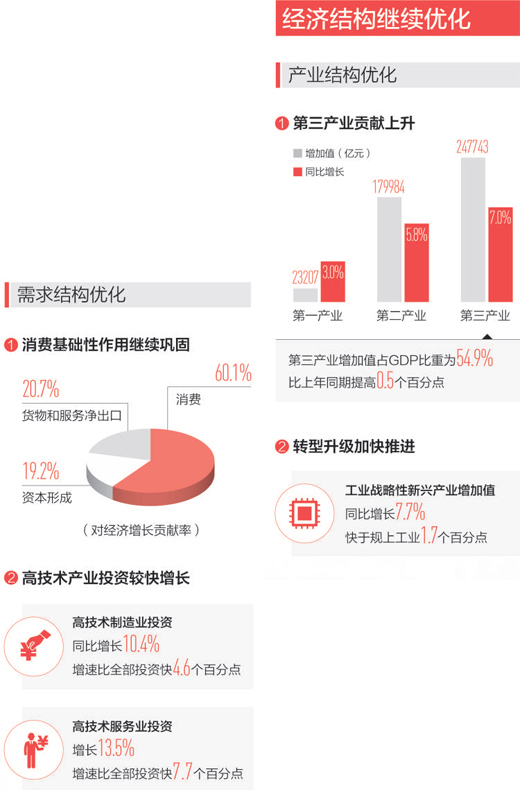
The demand structure is improving. The fundamental role of consumption continued to be consolidated. In the first half, the contribution rate of final consumption expenditure to economic growth reached 60.1 percent. Of all resident final consumption expenditure, service consumption accounted for 49.4 percent, up 0.6 percentage points from the same period last year. The investment structure also showed an improving trend. For example, investment in the social sector, high-tech industries, and technological transformation of manufacturing all remained at a good level of above 10 percent.
Industrial structure is improving. In the first half of the year, the added value of the tertiary industry accounted for 54.9% of GDP, up 0.5 percentage points from the same period last year and 15 percentage points higher than the secondary industry. The contribution of tertiary industry growth to GDP growth was 60.3%, 23.2 percentage points higher than that of the secondary industry. The internal structure of industries is also being optimized. In the first half of the year, the added value of high-tech manufacturing increased by 9%, 3 percentage points faster than that of industrial enterprises above designated size. The share of high-tech manufacturing added value in the total added value of industrial enterprises above designated size increased by 0.8 percentage points year on year.
Regional development has become more coordinated. In the first half of the year, the value added of industrial enterprises above designated size in the central region increased by 8.4% year on year, 3.5 percentage points faster than that in the eastern region; the growth rates of fixed asset investment in the central and western regions were also faster than that in the eastern region. A series of major regional strategies, including the coordinated development of the Beijing-Tianjin-Hebei region, the Yangtze Economic Belt, the Guangdong-Hong Kong-Macao Greater Bay Area, and the integrated development of the Yangtze River Delta, have been steadily advanced, and a new pattern of interconnected development across the country is taking shape.
Question: Is there enough momentum?
No matter how the external environment changes, we need to focus more on ourselves and do our own work well. Observant people will notice that in June, the growth rates of the value added of industrial enterprises above designated size and total retail sales of consumer goods were 6.3% and 9.8% year on year, respectively, up 1.3 and 1.2 percentage points from May; the investment growth rate in the first half of the year was also 0.2 percentage points higher than that in the first five months.
Earlier, some people expressed concerns that China's economic growth lacked sufficient momentum. Why did the major indicators rebound to varying degrees in June?
Let's start with consumption. Mao Shengyong explained that the rebound in total retail sales of consumer goods in June was mainly due to two reasons. First, automobile sales performed well, better than expected. The implementation of the China VI motor vehicle emission standard intensified automobile promotions, and sales of automobiles by units above designated size grew by more than 17% in June, contributing about 1.6 percentage points to the growth of total retail sales of consumer goods. Second, the "6·18" promotional activities in June made online retail perform well, with relatively fast growth in online sales of cosmetics and home appliances.
Now for investment. In the first half of the year, fixed asset investment increased by 5.8% year on year, 0.2 percentage points faster than in the first five months. Among them, the growth rates of manufacturing investment and infrastructure investment rebounded by 0.3 percentage points and 0.1 percentage points, respectively.
Mao Shengyong said that since the end of last year, in response to a series of uncertainties in economic operation, the central government has introduced a series of policies and continuously strengthened their implementation, including a proactive fiscal policy with greater intensity and effectiveness, a prudent monetary policy that is flexible and appropriate, and a proactive employment policy that has been fully implemented. These policies have begun to take effect in April and May this year.
"From our research, enterprises have a relatively good sense of gaining from tax and fee reductions. In the first six months, infrastructure investment growth picked up, and manufacturing investment growth also rebounded slightly in the last two months, indicating that the policies are already producing effects," Mao Shengyong said. He said he expects the effects of these policies to continue to show in the second half of the year, including increasing the issuance of special bonds and introducing new measures, which have indeed accelerated the approval of major projects to shore up weak links and strengthen momentum. In the next stage, these projects will be implemented and deliver results one after another, so infrastructure investment is expected to rebound from a low base. "In the next stage, with policies implemented and delivered, we will further deepen reforms, improve the business environment, and further stimulate the vitality of market entities. We expect investment to perform better in the second half of the year." If external uncertainties continue to intensify in the second half of the year, how can China's economy maintain stable operation?
Mao Shengyong said, "Global economic growth is slowing overall, and the external environment we face is more complex than before. Looking to the next stage, no matter how the external environment changes, we need to focus more on ourselves, do our own work well, keep the economy running stably within a reasonable range, and further move toward high-quality development."