
Summary: Goldman Sachs recently released its top 10 investment themes for 2021, predicting that commodities will enter a new bull market next year. Non-energy commodities are expected to rise in the near term, while energy commodities will rally after winter.
What investment opportunities will 2021 bring?
Goldman Sachs recently released its top 10 investment themes for 2021, predicting that commodities will enter a new bull market next year. Non-energy commodities are expected to rise in the near term, while energy commodities will rally after winter.
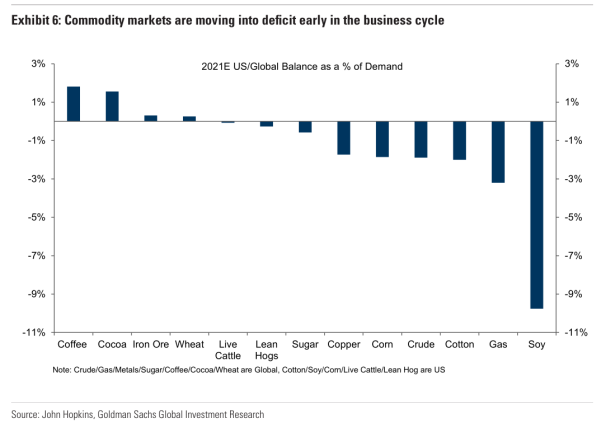
Goldman Sachs noted that years of underinvestment in the traditional economy have left traditional commodity production capacity limited. Even amid the uncertain outlook for demand recovery, inventories of major commodities are already tightening. Therefore, Goldman Sachs believes that with the wide rollout of COVID-19 vaccines driving a strong demand recovery, commodities will usher in a new bull market in 2021.
Last month, Goldman Sachs pointed out in another report that the three macro trends supporting a bullish view on commodities are more stimulus measures, a weaker dollar, and inflation risks.
Assuming the larger stimulus package proposed by the Democrats is passed, Goldman Sachs estimates that U.S. industrial production will grow by 4-5% by 2024, which implies strong growth in future consumption of commodities such as crude oil.
In addition, Goldman Sachs said that many countries are carrying out large-scale infrastructure construction in response to the pandemic, such as the EU's green economy initiative and China's new infrastructure drive, which will generate a new wave of demand. Goldman Sachs forecasts that these infrastructure projects will drive approximately $1 trillion in demand from 2021 to 2025.
Finally, Goldman Sachs noted that the Federal Reserve's commitment to keeping interest rates near zero for the next few years could lead to a weaker dollar over the long term, which would be favorable for commodity prices. Sustained rises in raw material prices will ultimately push inflation higher.
Breaking it down, the bull cycles for energy and non-energy commodities may not be synchronized.
Goldman Sachs believes the bull market in energy commodities will not arrive too quickly, with prices likely to rise only after winter, while non-energy commodities such as metals have already begun their bull cycle.
Oil inventories remain high, and energy commodity prices may stay in a phase of subdued performance for a while. Recent average international crude oil prices are already in the floor price range. There are still three potential bearish factors in the coming weeks: repeated outbreaks of the pandemic, a second lockdown in the U.S., and the aftermath of the U.S. election. This suggests that crude oil prices will remain volatile throughout November and may even decline in the short term.
However, Goldman Sachs believes that if oil prices remain persistently low, they will further curb supply. By then, a full demand recovery led by vaccines, insufficient supply, and damaged shale oil development will combine to trigger a substantial rebound in oil prices.
Goldman Sachs expects Brent crude to reach $65 per barrel by the end of 2021, compared with its current price of around $40 per barrel.
Goldman Sachs also believes that non-energy commodities such as metals and agricultural products have considerable upside potential in the near term. Strong demand from China and adverse climate factors have already tightened inventories of these commodities ahead of time.
Goldman Sachs expects copper prices to reach $7,500 per metric ton by the end of 2021, with current spot prices at around $6,900 per metric ton.