Summary: A report released by the World Trade Organization on the 20th showed that global merchandise trade rebounded strongly in recent months, but it remains uncertain whether this growth can be sustained in the future.
A report released by the World Trade Organization on the 20th showed that global merchandise trade rebounded strongly in recent months, but it remains uncertain whether this growth can be sustained in the future.
The report noted that in the second quarter, many countries imposed restrictions to curb the spread of the novel coronavirus, leading to sharp declines in both trade and output. In the third quarter, as restrictions were eased, global trade saw a strong rebound. However, with pent-up social demand largely released and inventory restocking basically completed, trade growth is expected to slow in the fourth quarter.
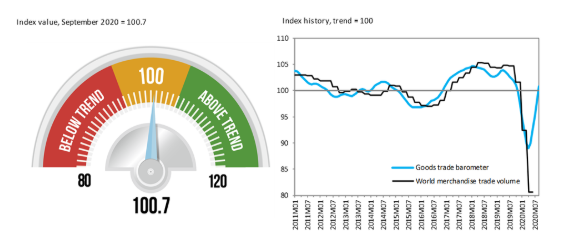
The WTO's latest Goods Trade Barometer, released Friday, showed the global goods trade sentiment index at 100.7, a sharp increase from 84.5 in August.
The Goods Trade Barometer is designed to provide real-time measurement of momentum and turning points in world trade growth. An index value of 100 indicates expansion in line with medium-term trends; above 100 means growth is above trend, while below 100 means growth is below trend.
In recent months, all sub-indices of the barometer have risen, with some exceeding medium-term trends. Among them, the export orders index (113.5) and agricultural raw materials index (103.6) drove the overall recovery, both steadily above trend levels. The container shipping index (102.0) and automobile products index (94.6) also rebounded significantly to near trend levels, while the air freight index (88.5) and electronic components index (94.6) remained below trend.
Under normal circumstances, the goods trade barometer can predict turning points in world trade several months ahead. However, new uncertainties related to the COVID-19 pandemic may have reduced the predictive value of its component indices. In this context, higher-frequency statistics (daily or weekly) may offer more signals on economic activity and trade.
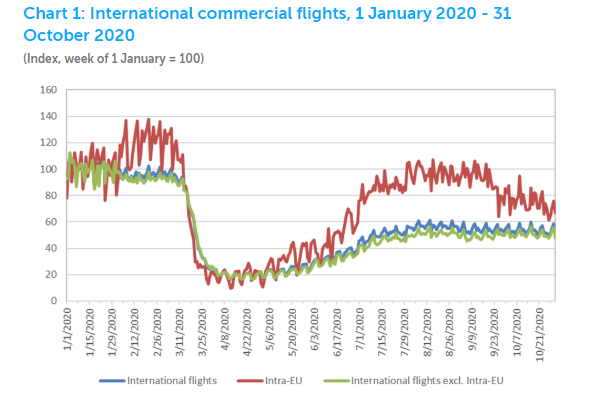
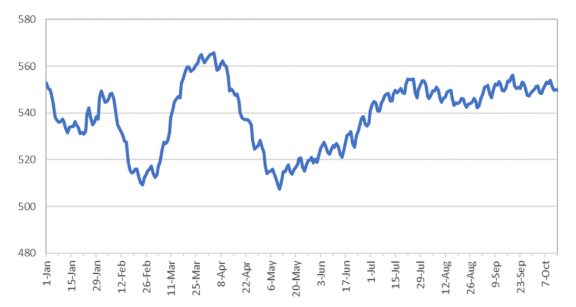
These data suggest that the recovery in international flights and container shipping stalled in October, while economic sentiment reflected in copper futures and news reports improved.
The following chart shows the trends in international flights and international container shipping this year: Note: The blue line represents global international flights; the red line represents cross-border flights within the EU. The recent second wave of infections in Europe has led to a marked decline in cross-border flights. Note: The chart shows the number of container ships docking daily as counted by the International Maritime Organization.
In October, the WTO forecast that global merchandise trade volume would contract by 9.2% this year and grow by 7.2% next year, but trade levels would remain well below pre-pandemic levels.
The WTO first released its global trade sentiment index in July 2016. By collecting trade statistics from major economies, it provides early signals on the short-term trajectory of world trade, offering more timely international trade information to trade policymakers and the business community. Since September 2019, the WTO has released the Goods Trade Barometer and Services Trade Barometer reports separately, replacing the previous global trade sentiment index report.