
Abstract: Factors influencing the corrosion resistance of trivalent chromium passivation films on zinc coatings were analyzed from four aspects: surface protection level design, production site management, passivation process parameter control, and sealing process. The results show that for automotive OEMs to obtain trivalent chromium passivated products with high corrosion resistance, the technical and process level of electroplating material suppliers is key, while the production site management level of electroplating manufacturers should also not be neglected.
Keywords: zinc coating; trivalent chromium passivation film; corrosion resistance
Chinese Library Classification: TQ153.1+5 Document code: B
Traditional zinc passivation uses a hexavalent chromium passivation process. This passivation film has the advantages of strong decorative appearance, good corrosion resistance, and self-healing ability, and thus has been widely used. However, hexavalent chromium is a highly toxic substance, with carcinogenic, teratogenic, and gene-mutation-inducing hazards, seriously polluting the environment and endangering human health, so its use has been strictly restricted. The toxicity of trivalent chromium is about 1% of that of hexavalent chromium. In line with the development trend of cleaner production, the use of trivalent chromium passivation has become the mainstream. For automotive OEMs, the most important concern is the corrosion resistance of the trivalent chromium passivation film, that is, the time to white rust and the time to red rust in the neutral salt spray test. The former mainly depends on the quality of the passivation film and the sealing effect, while the latter mainly depends on the thickness of the zinc coating and the type of zinc plating process.
1. Film formation mechanism of trivalent chromium passivation film
The main components of the trivalent chromium passivation solution are trivalent chromium, oxidizer, film-forming accelerator, complexing agent, and additives.
The main film-forming reactions of the trivalent chromium passivation film are as follows.
2. Main characteristics of trivalent chromium passivation film
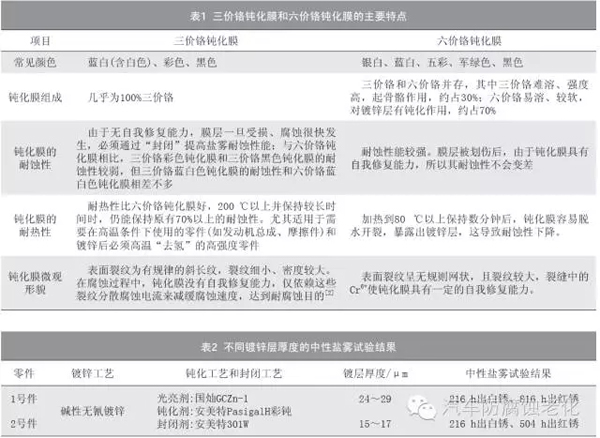
The main characteristics of trivalent chromium passivation film and hexavalent chromium passivation film are shown in Table 1.
3. Factors affecting the corrosion resistance of trivalent chromium passivation film
3.1 Factors in surface protection level design
3.1.1 Average and minimum thickness of zinc coating
The red rust time of the passivated zinc coating in the neutral salt spray test is directly related to the thickness of the zinc coating. To obtain good corrosion resistance, the minimum thickness of the zinc coating is generally required to be <6 μm. In addition, if the zinc layer is too thin, the coating can be dissolved through during passivation. The neutral salt spray test results for different coating thicknesses are shown in Table 2.
3.1.2 Zinc plating process and brightener
At present, alkaline cyanide-free zinc plating and acid zinc plating are the two main zinc plating processes, with alkaline cyanide-free zinc plating being the mainstream in the automotive manufacturing industry. Generally, the corrosion resistance of alkaline cyanide-free zinc plating is significantly better than that of acid zinc plating. This is because different zinc plating processes use different brighteners, which affect the formation process and inherent characteristics of the zinc coating, thereby affecting the film-forming quality, adhesion, and corrosion resistance of the passivation film. In addition, when different brighteners are used in the same process, the corrosion resistance of the trivalent chromium passivation film can also vary greatly because of differences in the crystal state, compactness, and proportion of organic inclusions in the zinc coating. The main differences between alkaline cyanide-free zinc plating and acid zinc plating are shown in Table 3.
3.1.3 Zinc plating method
When the electroplating process, passivation process, and zinc coating thickness are the same, the corrosion resistance of rack-plated zinc parts is obviously better than that of barrel-plated zinc parts. This is because barrel-plated parts can only be plated at a lower current density (otherwise the coating at edges and corners is easily burned), so the coating in the low-current area is very thin. In addition, barrel-plated zinc parts are prone to collision and scratching during passivation, which is also one of the main reasons for their poor corrosion resistance.
3.1.4 Appearance of passivation film
For the corrosion resistance of trivalent chromium zinc passivation film, iridescent passivation film is better than black passivation film, and black passivation film is better than blue-white passivation film. Among them, the iridescent and blue-white passivation processes are relatively mature, while black passivation is still not stable enough and cannot fully meet the requirements of actual production. The neutral salt spray test results of Phoenix pas 600 trivalent chromium black passivation and Phoenix pas 397 trivalent chromium iridescent passivation are shown in Table 4.
3.2 Factors in production site management
3.2.1 Periodically analyze the composition of the passivation solution
During passivation, the zinc coating is dissolved and oxidized, and the Zn2+ concentration in the passivation solution increases continuously. When the Zn2+ concentration in the passivation solution is too high, it will affect the normal progress of the passivation process, affect the control of passivation time, and ultimately affect the corrosion resistance. Therefore, it is necessary to regularly detect the mass concentration of Zn2+ and harmful impurity ions (such as Fe2+ and Cu2+) to avoid problems such as poor color appearance, fogging, and a large decline in corrosion resistance caused by imbalance of the passivation solution, while also extending the service life of the passivation solution.
3.2.2 Drying temperature
The newly formed trivalent chromium passivation film after passivation is soft, has a high water content, and has poor film strength. It must be dried at a higher temperature for an appropriate time (i.e., "aging treatment"). Generally, the drying temperature is 60–80 °C. If the drying temperature is too high or the drying time is too long, the passivation film will dehydrate excessively and crack, reducing the neutral salt spray corrosion resistance of the film. However, the drying temperature should not be too low either; if aging is insufficient, the corrosion resistance will also decline.
3.2.3 Operating procedure specifications
a. Pure water should be used to prepare the trivalent chromium passivation solution, because water quality directly affects the performance of the passivation film.
b. For passivation of barrel-plated parts, a polypropylene basket should be used instead of a stainless steel basket. Because the passivation film is very delicate, barrel-plated parts should be dried by rotation; rack-plated parts should be blown dry with a cold air gun before drying to avoid run marks.
c. Trivalent chromium passivation should be performed by skilled operators, and hexavalent chromium passivation production habits should be avoided, such as suddenly accelerating the centrifuge immediately after pouring passivated barrel-plated zinc parts into it, or stacking and handling dried rack-plated parts without individual packaging.
d. Regularly maintain the passivation tank equipment, frequently fish out workpieces that fall into the passivation tank, and clean the internal sludge to extend the service life of the passivation solution.
3.2.4 Part collision
The trivalent chromium passivation film is not allowed to be bumped or scratched either before or after drying, so attention should be paid to packaging quality during transport.
3.3 Influence of passivation process parameters
3.3.1 Volume fraction of passivating agent
The volume fraction of passivating agent is mostly 10%–20%. In production, the passivating agent should be correctly and timely replenished and adjusted to ensure the corrosion resistance of the passivation film.
3.3.2 Passivation time
The trivalent chromium passivation film forms slowly and requires a long immersion time. At room temperature, it usually takes more than 45 s to obtain a passivation film with high protective performance. The passivation time is generally 60–90 s.
3.3.3 pH value of the passivation solution
The pH value of the passivation solution directly affects the corrosion resistance of the passivation film. Therefore, the pH value should be regularly tested and adjusted to ensure it is within the optimal process range. The pH value is generally 2.0–2.4.
3.3.4 Passivation temperature
If the passivation temperature is low, the film formation rate is slow, the film is thin, and the corrosion resistance is poor. If the passivation temperature is high, the decomposition of surfactants and brighteners in the passivation solution intensifies, making film formation difficult, the film structure loose, and the corrosion resistance of the film decreased. Generally, the passivation temperature is 20–70 °C, and the specific temperature varies depending on the passivation system.
3.4 Factors Affecting the Post-Passivation Sealing Process
3.4.1 Types of Sealing Agents
Sealing improves the corrosion resistance of the passivation film (white rust and red rust resistance time), enhances its temperature resistance and wear resistance, and improves the appearance quality of the product. In addition, lubricating and friction-reducing agents can be added to the sealing agent to adjust the surface friction coefficient of zinc-plated fasteners after passivation. The neutral salt spray test results for different types of sealing agents are shown in Table 5.
3.4.2 Different Sealing Processes
The trivalent chromium passivation process has two process routes: the typical process and the simplified process. The simplified process combines passivation and sealing into one step, which simplifies the passivation process and improves production efficiency. In addition, the passivation–sealing composite film formed by the simplified process can simultaneously meet the requirements of appearance, mechanical properties (friction coefficient), and corrosion resistance. Therefore, compared with the typical process, the simplified process has obvious advantages.
The latest generation of sealing technology directly adds a sealing agent into the passivation solution. The sealing agent uses nano-scale particles that can fill cracks and pores in the passivation film, making the film denser and greatly improving its corrosion resistance, which can reach or even exceed the corrosion resistance of traditional hexavalent chromium passivation processes.