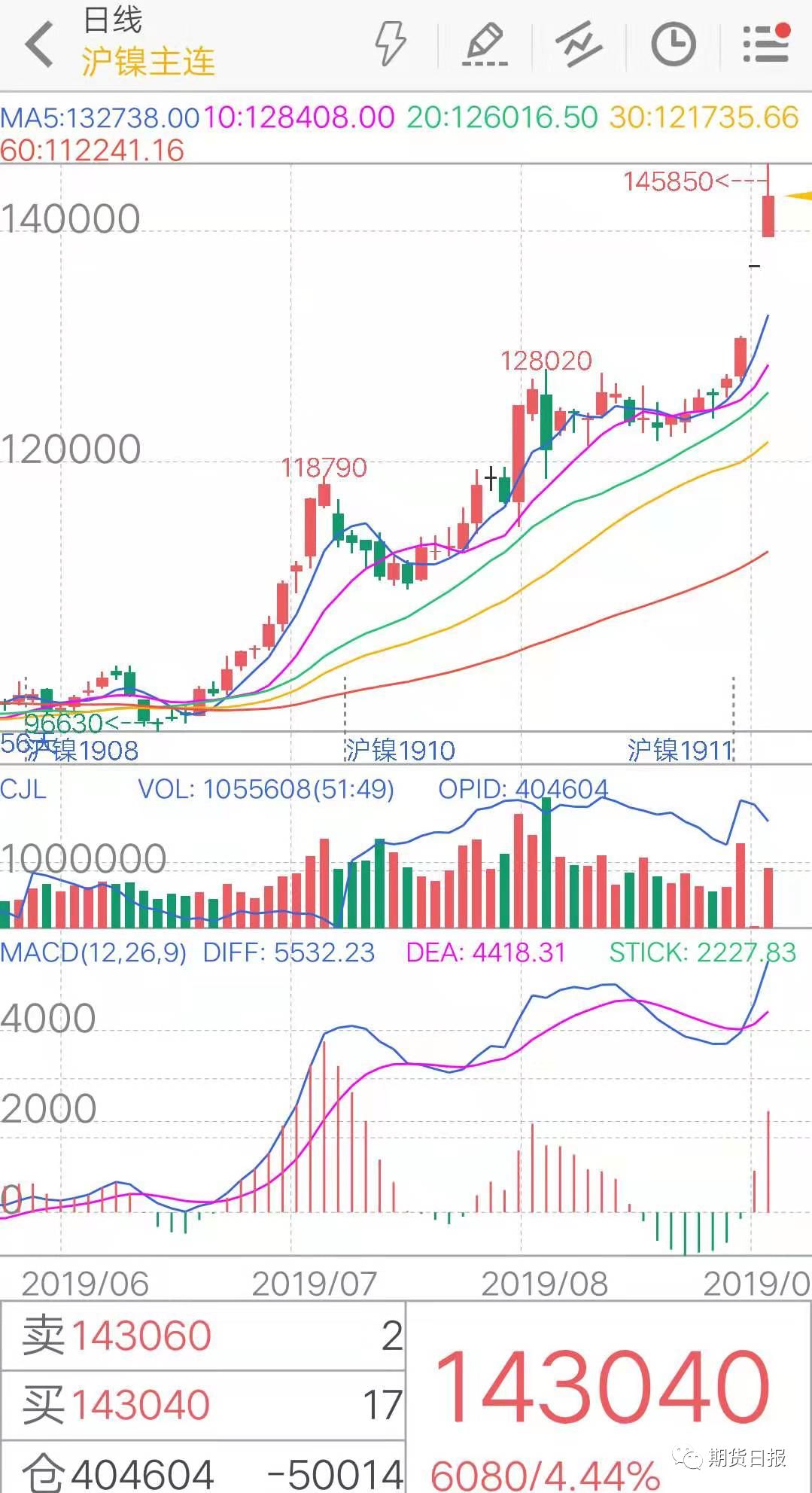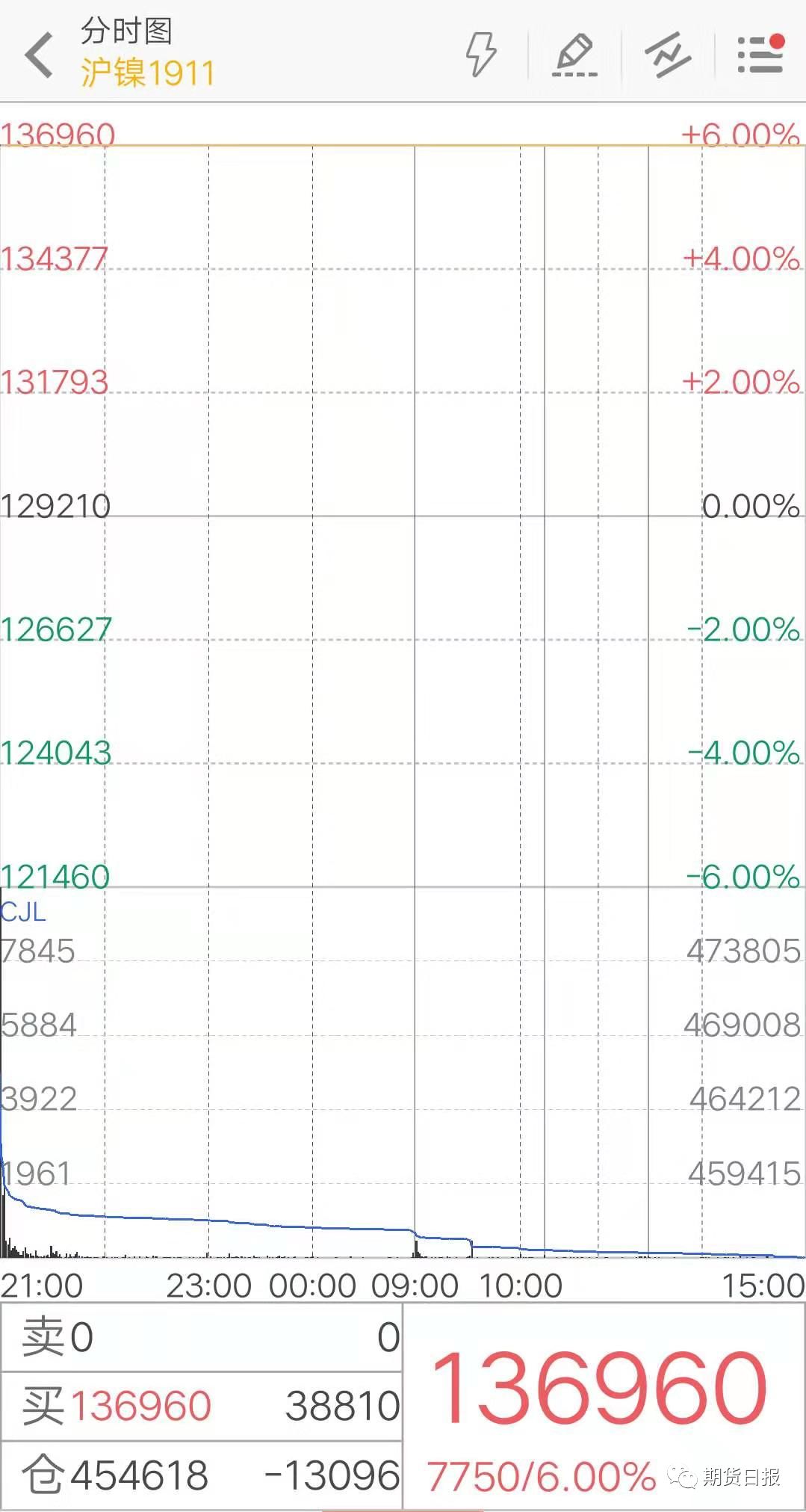
Over the past two days, under the heavy impact of Indonesia's mining ban policy, Shanghai nickel prices have continued to hit record highs since listing. Last Friday's night session, the main Shanghai nickel contract opened limit-up, and during the day session on September 2, it remained limit-up until the close, finally settling at 136,960 yuan/ton, up 6%. In the night session yesterday, Shanghai nickel continued to surge, at one point rising more than 6% intraday to a high of 145,850 yuan/ton, continuously setting new price highs. Since the rally began in early June, the cumulative maximum gain of the main Shanghai nickel contract over the past three months has exceeded 50%.
The latest news shows that Indonesian authorities have finally confirmed that nickel ore exports will be banned on January 1, 2020, two years earlier than previously announced.
What impact will Indonesia's mining ban have?
"In 2014, Indonesia's mining ban once pushed nickel prices up by nearly 50% within six months," said the non-ferrous team at Guoxin Futures. After Indonesia relaxed its nickel ore export policy in 2017, China's imports of nickel ore from Indonesia accounted for more than one-third of total imports. Relevant data show that from January to August 2019, China imported 17.16 million wet metric tons of laterite nickel ore from Indonesia.
According to Cao Yang, senior non-ferrous analyst at Orient Futures Derivatives Research Institute, if Indonesia strictly enforces the nickel ore export ban in 2020, China's nickel ore imports will face a shortfall of at least 20 million physical tons, while the amount that other regions can make up is not expected to exceed 5 million tons.
Specifically, in the Philippines, after Indonesia's first mining ban in 2014, Philippine nickel ore exports to China increased significantly, with an increment of about 6.83 million physical tons at that time. Assuming Indonesia bans mining again next year, Philippine nickel ore exports would need to increase by more than 6 million tons, which is quite difficult. In New Caledonia, the country has a quota export system, under which Eramet holds an export quota of 4 million physical tons. The company is expected to export 1.5 million physical tons of nickel ore in 2019. Assuming it fully uses its quota in 2020, it could fill a gap of 2.5 million physical tons. As for other regions, such as Guatemala, although some incremental supply may also emerge, the overall space is limited.
Wang Yanqing, non-ferrous analyst at CITIC Futures, said that since Indonesia still has some unused nickel ore export quotas, nickel ore supply is expected to remain relatively stable before the end of 2019. "With still four months to go before the ban takes effect, a rush in Indonesian nickel ore exports cannot be ruled out," said Cao Yang. Since there are still nearly 30 million physical tons of available quotas, if more than 10 million tons of 'inventory' can be shipped to China within four months, coupled with current port inventory, domestic nickel pig iron plants may not face the dilemma of 'cooking without rice' next year. However, the price to pay is that domestic nickel ore prices are likely to keep rising over the next four months.
At the same time, consideration must be given to whether Indonesia can supply nickel through processed forms such as ferronickel. Wang Yanqing noted that due to the massive construction of ferronickel capacity in Indonesia, it is expected that 530,000 metal tons of ferronickel capacity will be in place by the end of 2019. By then, Indonesia will supply nickel in the form of ferronickel, but the increment from Indonesia will not fully offset the reduction in domestic ferronickel, which may lead to a domestic ferronickel supply shortage of about 100,000 metal tons.
Cao Yang believes that the earlier-than-expected mining ban will accelerate the reduction of domestic ferronickel capacity, essentially speeding up the shift of raw material supply in the stainless steel industry chain overseas. In 2020, Indonesia still has a large amount of ferronickel capacity to be commissioned and ramped up. Conservatively estimated, more than 20 production lines are yet to be released, with annual capacity exceeding 1.5 million physical tons per year, equivalent to more than 10 million wet tons of 1.7% nickel ore. This will indirectly export Indonesia's nickel ore resources in the form of ferronickel. If these ferronickel exports go to China, the impact of the mining ban on stainless steel raw materials will be significantly reduced.
How will nickel prices perform going forward?
"The nickel market has now fully entered a bullish trend, and concerns over supply will continue to disturb the market. Nickel prices will likely continue to surge in the near term," Wang Yanqing said. The Indonesian mining ban undoubtedly provides strong support for nickel prices in the short term, but he still holds a relatively neutral view over the long term, and attention should be paid to Indonesia's capacity construction and downstream demand changes.
"Indonesia's nickel industry chain is gradually being improved, with some ferronickel and stainless steel capacity already built and put into operation. With the earlier mining ban, Indonesia's capacity construction may accelerate. At the same time, during the sharp rise in nickel prices earlier, stainless steel prices lagged noticeably, which indirectly confirms the current weak demand. If demand continues to weaken, it will also put downward pressure on nickel prices," he said.
Cao Yang believes that the nickel market has entered a stage of sentiment-driven pricing. The Indonesian mining ban, as the core driver of this round of nickel price gains, has now landed, and its boost to bullish market sentiment has reached a climax. At the same time, given the pressure on the demand side, a shift in market sentiment has already quietly begun. "Nickel prices may gradually enter a downward cycle after a short-term surge. In terms of operations, a short-term long bias is recommended, with a target price of 150,000 yuan/ton for the main Shanghai nickel contract. For short positions, one still needs to wait patiently for sentiment changes, and right-side trading is recommended."